It’s how the reception environment has been designed, and I don’t just mean how it looks. I mean, how it works.
Why Reception Design Matters More Than You Think
Your reception area sets the rhythm of your entire clinic; it’s the heartbeat.
If it’s clunky, confusing, or crowded, patients feel it immediately. Delays build up, your team feels pressure, and your day starts to drift off course.
But when it’s designed well, everything just flows as it should:
-
Patients know where to go
-
Your team knows what to do
-
Appointments stay on time
-
And the whole experience feels calm and professional
Good design reduces friction, and less friction means better flow.
Start With the Patient Journey
Before moving furniture or buying new chairs, take a step back and map out the patient journey.
Ask yourself:
If a new patient has to hesitate, look around, or ask basic questions, your system is already under strain.
Clarity beats cleverness every time, and as I say at all my workshops, “A confused mind says no”.
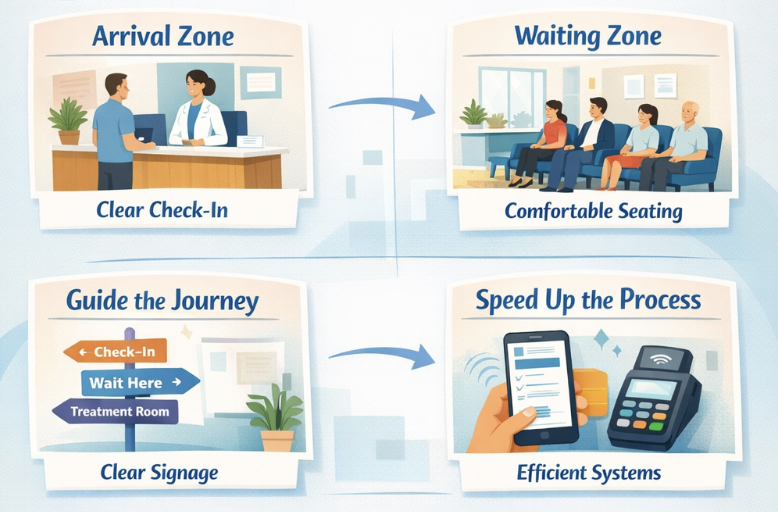
Zoning Your Reception Space
One of the simplest ways to improve flow is to create clear zones within your reception area. Think of it like a well-run airport (just without the delays and overpriced coffee).
You should have:
-
Arrival Zone – where patients check in
-
Waiting Zone – where they can sit comfortably without crowding the desk
-
Departing Zone – Once their treatment has concluded, having a defined payment area can be helpful.
When these zones overlap too much, congestion builds, frustrations build, and time is wasted. When they’re clearly defined, movement becomes natural and effortless.
The Reception Desk: Command Centre, Not Roadblock
Your reception desk should act like a central command centre. Too often, desks are oversized for the space, cluttered, or positioned in a way that creates a barrier between staff and patients.
Instead:
-
Keep it visually open and approachable
-
Minimise clutter (yes, minimise clutter). Go and look at your reception desk right now. Is it cluttered?
-
Ensure staff can easily see who is arriving and waiting
If your receptionist has to constantly lean, twist, or step away to manage patients, your layout is working against you.
Reduce Decision Fatigue for Patients
Every extra decision you force a patient to make slows things down.
- Where do I sit?
- Do I check in here?
- Am I in the right place?
These tiny micro-moments add up. But the good news is you can eliminate them with:
The goal is to make the next step obvious without needing to ask.
Seating: Comfort Without Congestion
Seating is often overlooked, but it plays a big role in flow. If you have too much seating, the reception can look crowded. But if you have too few seats, it can create anxiety and make patients feel awkward.
Aim for:
-
Enough seating for your peak times
-
Space between chairs for easy movement
-
A layout that doesn’t block walkways or the reception desk
- Select seating that best suits your space. Chairs with armrests may be beneficial for some patients, but they do take up far more room.
Patients should be able to sit, stand, and move without creating traffic jams or inconvenience others patients coming and going.
Technology That Speeds Things Up
Used well, technology can dramatically improve patient flow.
Consider:
-
Online forms completed before arrival
-
Contactless or quick check-in systems
-
Efficient payment processes
The less admin the patient needs to do at the front desk, the less congestion there will be, and the smoother your reception will run.
But a quick warning, technology should simplify, not complicate. If it confuses patients, it defeats the purpose.
Train Your Team to Match the Environment
Even the best-designed reception area will fail without the right behaviours.
Your team should:
-
Acknowledge patients immediately when they first arrive
-
Guide them clearly through the process
-
Communicate delays proactively if a podiatrist is running late
-
Work together to maintain flow during busy periods
Environment and behaviour must work hand in hand, and everyone in your team should be aware of peak times.
Small Changes, Big Impact
You don’t need a full renovation of your clinic to improve patient flow. Sometimes the biggest wins come from small tweaks:
I’ve seen clinics transform their patient flow and clinical efficiency with changes that cost next to nothing.
When I do on-site clinical training days, I’m there to train the team, but I’m also paying attention to reception and the overall clinic flow.
Final Thoughts
Your reception area is more than a waiting room; it’s the central hub of your clinic. When it’s designed with flow in mind, everything improves:
So if your clinic feels like it’s constantly playing catch-up, don’t just look in the treatment rooms; take a good look at your front desk. Because that’s where the day really begins.
If you’d like help improving your clinic systems, patient flow, or overall business performance, feel free to reach out.
Sometimes an outside perspective is all it takes to spot the bottlenecks and turn them into smooth, repeatable systems that make your clinic easier to run and more enjoyable to work in.